Table of Contents
Open Table of Contents
It started with OpenClaw
Early April, a friend made me look at the exploding growth around OpenClaw.
I was curious, but not convinced. I had tried Copilot before, in the early “multiline autocomplete” phase. Nice, sometimes impressive, but not a game changer for me. Maybe also because in the last years I shipped software more through teams than through my own fingers. I was still close to code, but not always deep in code.
OpenClaw was different.
It was the first “coding agent” (technically it’s not a coding agent :D) that really pulled me in. It was just the first one using tools without too much restriction, getting its way around to understand the code base and looking up things on the internet etc. It could inspect files, run commands, make changes, fail, fix itself, and continue. It was fun to see what it was thinking and doing ;)
That was the click moment.
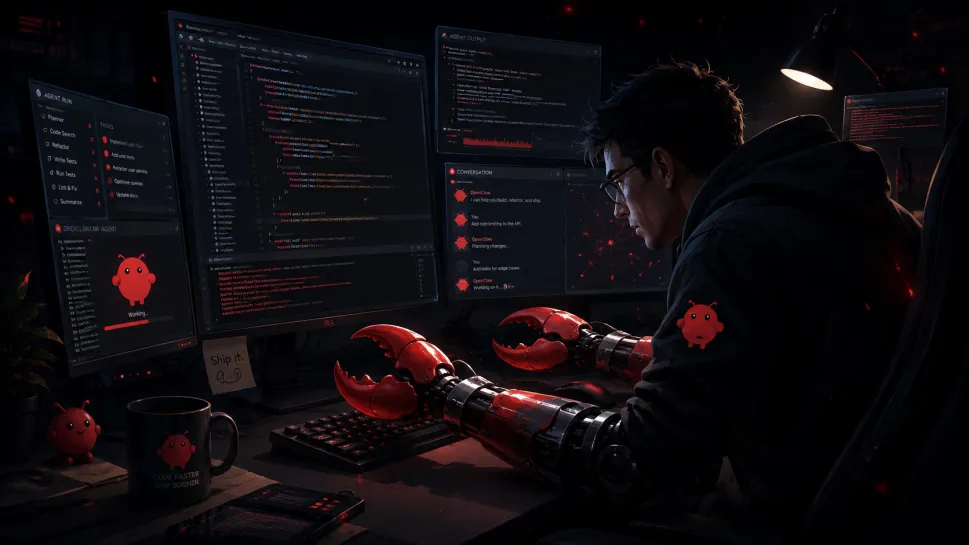
The bottleneck moved
After a few days I ran into the new vocabulary: tokens, context windows, compaction, lost context, model limits, tool calls, cost.
All of this was new to me in a practical sense. Of course I knew the words. But knowing them as concepts and feeling them while working are two different things.
So the bottleneck moved. Typing shifted from code to prompts and Markdown. Reviewing, thinking, planning became the new permanent activity. It seems that the bottleneck shifts to other things! Design taste, architecture! Testability! Organizing agent workflows - activities with new intensity! In the whole workflow, human attention becomes the bottleneck!
Very vampire-like, if you allow it. Eight, ten, twelve hours disappear very easily.
Codex, Gemini, Claude Code
Once I understood that OpenClaw was not a toy, I started to rediscover all the other harnesses I had somewhere in my todo list: Codex, Gemini, and the rest of the Cambrian explosion around coding agents. Once using Codex, I realized I didn’t need any of the OpenClaw bloat ;) (Obvious, I know :))
It made me curious to compare, and I liked Gemini too. Google models are different but great for research. Keeping them for my LLM tasks.
Then another friend insisted that I should try Claude Code. So I subscribed.
That rounded up the experience for me. Claude Code felt especially good in longer, more careful sessions. It was not only “write code”. It was closer to working with a very fast junior/senior hybrid who can do a lot, but still needs direction and boundaries.
If you look at my GitHub activity in that period, you can see it. There were not many days without commits, unless I was on the road. I don’t think I ever produced so much code over a longer span of time. At least if measured by lines of code, which is of course a very stupid metric. But still, the volume was real.

And then I found Pi…
Researching all of this quickly brought me to Pi, Mario Zechner’s minimal coding harness.
What the heck. On first glance it felt like the shell inside OpenClaw escaped and became its own thing. And that was exactly why it was fascinating to me. I liked OpenClaw because of the unrestricted tool access. Pi takes that idea seriously and then removes a lot of ceremony around it.
Before Pi I was already drawn into the research of the best skills, the best configuration of the Claude Code harness, experimenting with superpowers and other workflow skills…
With Pi, the whole thing returned back to my “engineering sense of a good and controllable tool”. Pi probably clicked into a Unix-like philosophy - do one thing but do it well! It also doesn’t assume too much about my task, my prompts; in other words, it doesn’t treat me as dumb! Pi accepts that I’m the experienced engineer and the human is in the driving seat!
But! Pi harness deserves a separate article! I would like to stop here.
Old todos suddenly became doable
I started with small tasks. The kind of tasks that sit in a list forever because they are never urgent enough.
Realizing I have these “artificial claws”, I started building servdir, a small service catalog I wanted for a long time. I migrated this blog to Astro.
The same happened with a few other “waiting todos”. I created an Astro + Tailwind + DaisyUI starter, not because the world needed another starter, but because the world needed clean Astro baseline for my and other people’s projects :). And then I’ve started ibcli, an Interactive Brokers CLI PoC. (This tool version uses the web API without GW installation, so unfortunately it is only useful for resellers, not private accounts.)
And recently I’ve made tl tool (a task ledger), because Beads felt just too much and maybe too bloated for my use cases (while still being great!).
So, agents gave me the time and “hands” to accomplish boring-but-useful things! And finally gave me time to start new endeavors - there is more predictability to accomplish them now!
Closing
So this is where I am after roughly six weeks with coding agents: slightly exhausted, very curious, and definitely pulled back into coding.
I’m still figuring out my workflow, especially around Pi, tasks, skills, and how much structure is actually helpful.
If you are using coding agents too, I would love to hear your experience. What works for you? What failed? Which harness, model, workflow, or task tracker did actually stick?
Ping or comment on X, Linkedin or wherever you prefer.