Table of Contents
Open Table of Contents
I’m one of those
I’m one of those people who jumped onto the new Omarchy Quattro release because I believe Linux has a real future on the desktop. For sure not because my previous setup was broken. Quite the opposite.
Fedora had been my reliable desktop for many years. I upgraded it release after release, kept my Fedora upgrade notes current, and rarely had a reason to question the basic choice. It was modern, stable enough, and very good at getting out of the way.
More recently, I moved from GNOME into Sway and started assembling a more keyboard-driven desktop myself: Sway, Waybar, Wofi, Mako, screenshot tools, portals, keyring integration, and the usual NVIDIA exceptions. That experiment taught me a lot. It also showed me how many separate pieces are needed before a tiling desktop feels complete.
[image hint: Fedora/Sway desktop next to the new Omarchy Quattro desktop]
The agentic era changes the workstation
The agentic era is changing tools and development paradigms insanely fast.
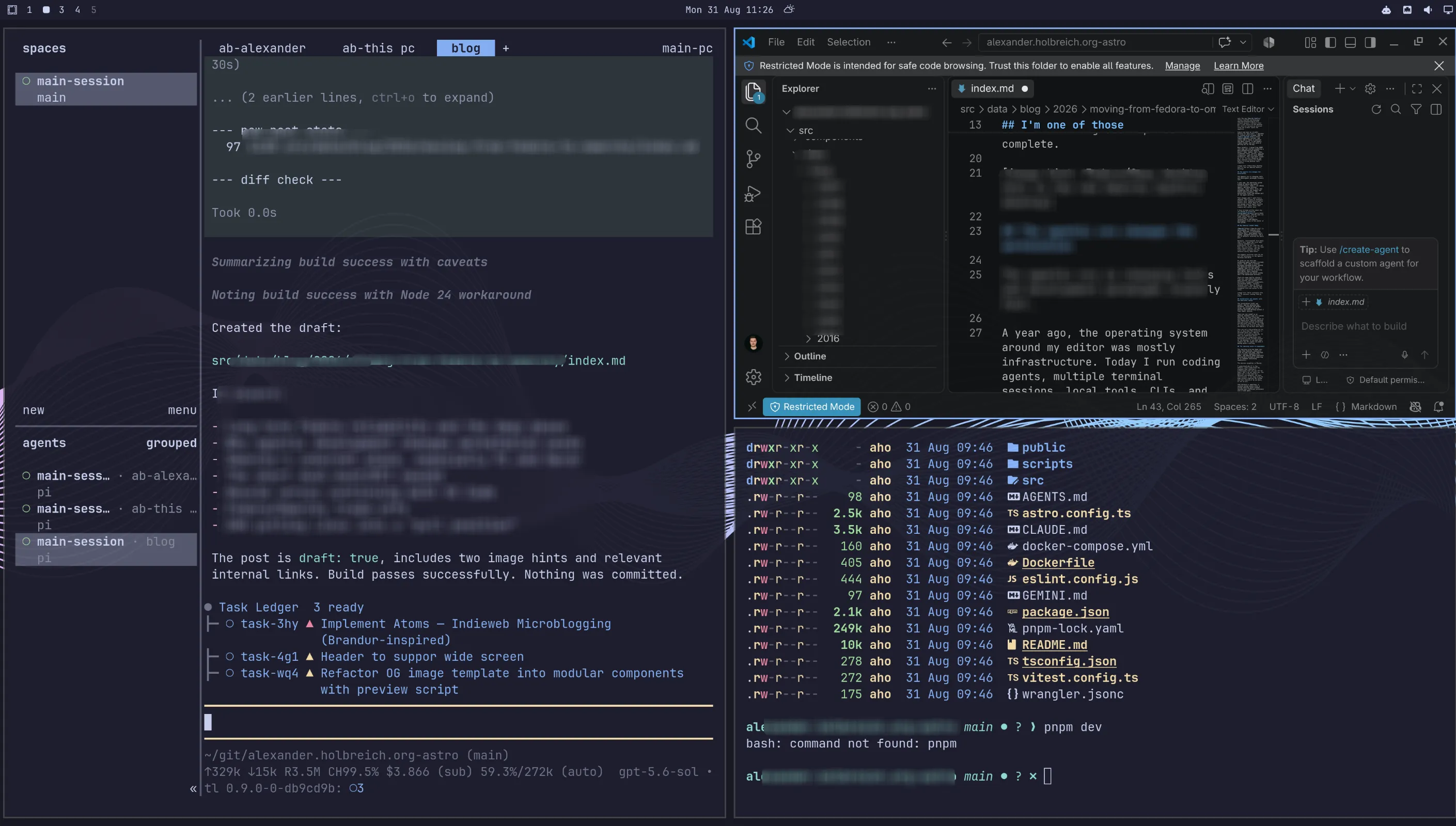
A year ago, the operating system around my editor was mostly infrastructure. Today I run coding agents, multiple terminal sessions, local tools, CLIs, and automation that can inspect and modify whole projects. The workstation itself has become part of the agent workflow.
That changes what I want from a desktop. Fast access to terminals matters more. Keyboard navigation matters more. Being able to see and manage several agent sessions matters more. Small tools that compose well matter more.
I have already written about why Pi became my preferred coding-agent harness. Omarchy does not treat tools like Pi as an afterthought. It puts terminal-first and agentic development close to the center of the system.
Why Omarchy looked ready
Omarchy is opinionated. It combines Arch Linux, Hyprland, a coordinated desktop shell, development tools, themes, keyboard shortcuts, and a set of defaults selected for daily work.
Normally, “opinionated” also means that I will spend the first days undoing somebody else’s preferences. So far, that has not been the case here. I may not keep every choice forever, but the stack feels coherent and the defaults mostly make sense.
The biggest practical wins for me are the nativeness to the Agentic Harneses and Herdr.
Pi gives me the thin and extensible agent harness I already prefer. Herdr adds a terminal workspace designed around running and observing multiple agents. Together they fit the way my development workflow is evolving much better than a desktop designed around one editor window and a few background terminals.
There are many smaller choices I like too: searchable keybindings, good launcher and clipboard workflows, integrated screenshots, coordinated themes, sensible terminal tools. None of these is revolutionary alone. Having them assembled into one system is the value.
Installation was smooth, with one dual-boot caveat
The installation itself was smooth. Omarchy detected the hardware, installed the NVIDIA setup, and brought me into a working Hyprland desktop without a long repair session.
There was one caveat on my machine. Windows (yes i still need that :( ) lives on a second disk, but its boot files had shared the EFI system partition on the Fedora disk. Omarchy replaced that partition without preserving the Microsoft boot files, so I had to restore them from my backup and add Windows to the boot menu again.
This was not a big problem for me, but it describes the installer’s attitude quite well: Omarchy focuses on installing Omarchy. It does not spend much effort protecting or integrating other operating systems already present on the machine. If you dual boot, inspect the EFI layout and make a backup before starting.
Then whole thing was done with pi of course. I dint execute any of the commands manually.
The learning curve is reasonable
The learning curve has been less steep than expected, especially after my time with Sway. Hyprland uses a similar keyboard-first model, and Omarchy makes shortcuts discoverable instead of expecting me to remember everything immediately.
The obvious exception is Neovim.
I understand why it is the default, I’m just not on the level with vim atm. The good news is that Omarchy’s opinions are defaults, not hard restrictions. I can keep using VS Code without fighting the system and learn Neovim at my own pace, or not at all.
That balance is important. A curated system should offer a strong starting point without turning every different preference into a side quest.
It must be said, i like the software stack. Also neovim makes totaly sense. Its just my lack of long exposure to this, but i’m catching up.
Fedora was not the problem
This migration is not a verdict against Fedora.
Fedora remains the more conservative and broadly integrated workstation. I gave up useful things such as enforcing SELinux, the rootless Podman and Toolbox workflow, and GNOME as a reliable fallback session. Omarchy is younger, faster-moving, and based on a rolling Arch foundation. I expect more change and probably more maintenance.
What I gained is a much more coherent terminal-first desktop with agent workflows already considered. Fedora gave me reliable components and the freedom to build my own environment. Omarchy gives me somebody’s well-rounded version of that environment, ready on the first day.
Right now, that trade feels appropriate for how I work.
Putting Linux into a pull position
I also want to support the direction behind Omarchy.
Linux desktop advocacy has spent many years pushing: explaining why Linux is good enough, why switching is not difficult, and how it can imitate the systems people already use. I believe DHH takes a timely step with Omarchy. He is rigth in the spot. This feels like unique opprotunity for Linux. Agentic revolution, Experienced Product creator (DHH) who is know in the market and has proven to have good taste (feel free to diasgree). He is able to atrrack money and direct sponsership to the right people and companies(?) that could finaly make Linux also first choice on the Desktop.
That puts Linux into a pull position.
Omarchy does not need to be the desktop for everyone. It can be the desktop that makes a particular group of developers curious again. If that group grows, improves the tools, reports hardware problems, and demonstrates serious daily use, the wider Linux desktop benefits too.
I want Linux to finally win on the desktop. Maybe “win” does not mean replacing every Windows and Mac installation. Maybe it starts with creating experiences people actively choose instead of merely accept.
Omarchy Quattro feels like one of those experiences.
It is still early for me, and I will see how the rolling updates, hardware support, video calls, and daily agent work hold up over time. For now, the migration has been surprisingly straightforward, and the whole stack feels ready for this new kind of development workflow.
Have you tried Omarchy, or built a similar agent-first workstation on another Linux distribution? What parts actually improved your daily work?